
A brand message is the short explanation of what you do, who it is for and why it matters. When it is clear, your website, social posts and sales conversations get easier to write and easier to understand. When it is vague, every piece of content has to start from scratch. This guide walks through how to build a message people can repeat after hearing it once.
Start with your audience
Describe the people you most want to help in specific terms: what they need, what frustrates them and what they have already tried. Talking to a few customers or reviewing past enquiries gives better material than assumptions.
The more precisely you understand them, the more naturally your message will speak to their situation.

Name the problem you solve
Customers rarely buy a service for its own sake. They want a result: more enquiries, a clearer website, less repetitive work. State the problem in their words before describing your solution.
A message that begins with the customer’s problem feels relevant straight away, while one that begins with your credentials often feels generic.
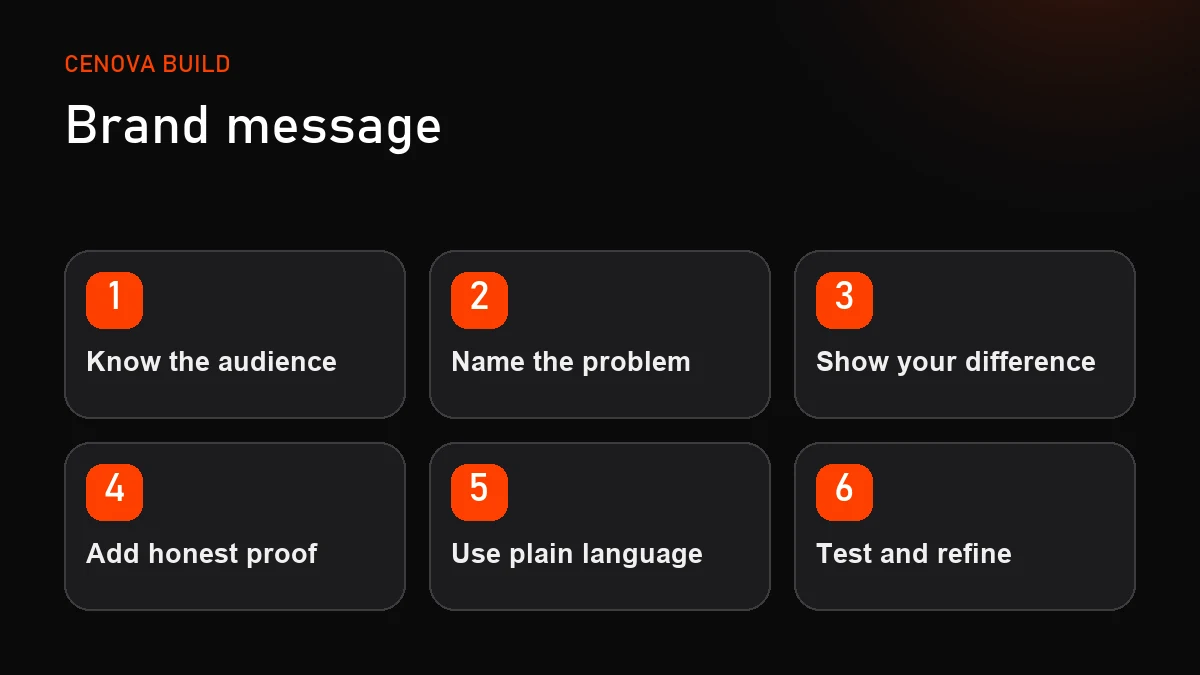
Explain what makes your approach different
Think about how you work, not only what you offer. It might be a particular process, a focus on a type of business, or the way you communicate and agree scope. Be specific and truthful.
- Avoid claims you cannot support, such as being the best
- Prefer concrete details: how you plan, review and report
- Link each difference to a benefit the customer cares about
- Keep it short enough to say in one breath
Add proof you can stand behind
Support your message with real evidence: how you work, examples with permission, honest reviews with their source, or clear descriptions of your process. Do not invent testimonials or results.
Proof does not need to be dramatic. Clear, accurate detail builds more trust than large claims.
Write it in plain language
Combine the pieces into one or two sentences: who you help, the problem you solve, how you do it and the result. Then rewrite it without jargon.
A useful test is to read it aloud. If it sounds like something you would say to a friend who asked what you do, it is close.
Test and refine the message
Share your draft with a few customers or people outside your industry and ask what they think you do. Their answers show where the wording confuses or misleads.
Revise until different people describe your business in similar terms, then use the same message across your site and profiles.
Common messaging mistakes
The most common is trying to speak to everyone. A message written for every possible customer usually connects with none of them. Choose the audience you serve best and write for them first.
Another is describing features instead of outcomes. Customers care about what changes for them: fewer delays, clearer pages, more qualified enquiries. Translate each feature into the result it creates.
Finally, avoid buzzwords that sound impressive but say little. Words like innovative, end-to-end and cutting-edge rarely help a reader decide. Specific, plain statements do.
A simple example
A small web studio’s early message was we create digital experiences. After talking to clients, it changed to we build clear, easy-to-edit WordPress websites for small businesses, with a plan and price agreed before work begins. This is an illustrative example, not a client result.
The second version says who, what and how, and it gives a visitor an immediate reason to keep reading.
Keep the message alive
Put your message where people see it first: the home page headline, social bios, email signatures and proposals. Revisit it when your services or customers change.
Consistency over time matters more than perfect wording, so choose a clear version and use it.
If you want help sharpening your message, our brand strategy team can run a short positioning review and turn it into website and content copy.
Related reading: Turn Brand Strategy into Everyday Communication · How to Brief a Website Project: A Practical Checklist
Frequently asked questions
What is a brand message?
A short, clear statement of who you help, the problem you solve, how you do it and why it matters to the customer.
How do I write a brand message?
Understand your audience, name their problem, explain what makes your approach different, add honest proof and rewrite it in plain language.
How long should a brand message be?
One or two sentences for the core message, supported by a few key points. If you cannot say it in one breath, simplify.
How can I test whether my message is clear?
Ask a few customers or people outside your industry what they think you do after reading it, and refine until their answers match your intent.
Where should I use my brand message?
On your home page headline, social profile bios, email signatures, proposals and advertisements, so people hear the same message everywhere.
