

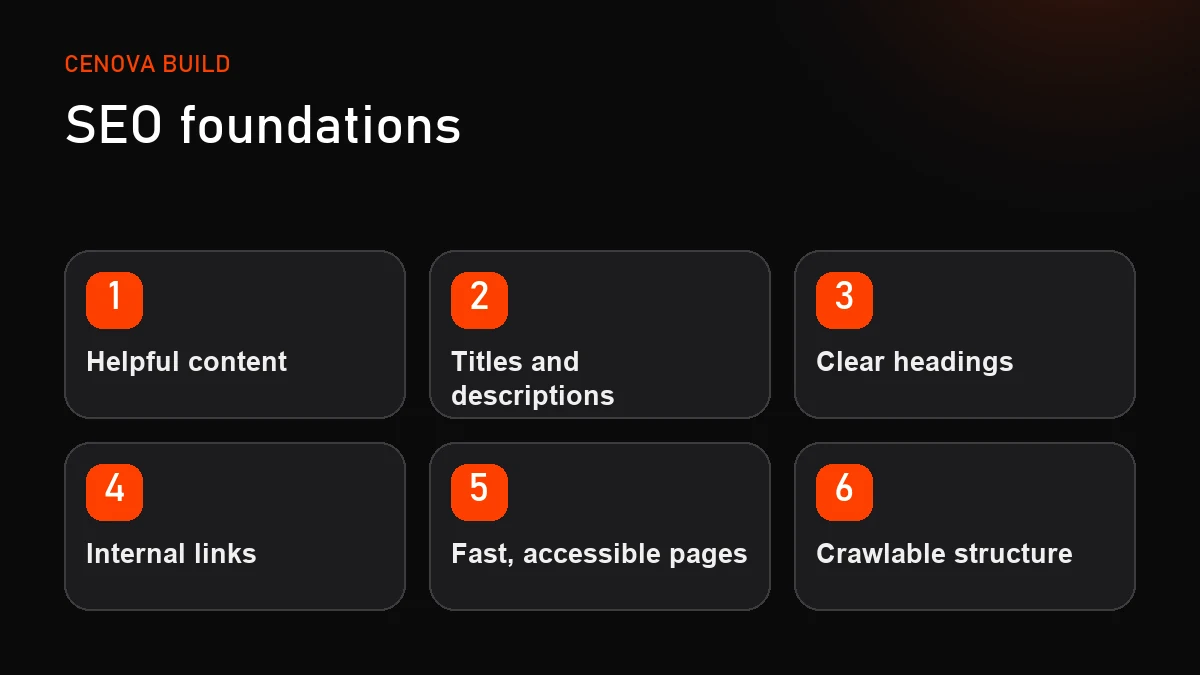
Search engine optimisation sounds technical, but its foundations are practical: make pages that answer real questions, describe them clearly, link them sensibly and keep the site fast and easy to use. None of this guarantees a particular ranking, and anyone who promises one should be treated carefully. What it does is give your site a sound base to be found. Here are the essentials.
Start with helpful content
Search engines aim to show people pages that answer their questions. Write for your visitors first: explain your services plainly, address common concerns and show how to take the next step.
Avoid padding pages with keywords. Use the words customers naturally use, and cover each topic clearly on a page of its own so that visitors and search engines know what it is about.

Write clear page titles and descriptions
The page title is one of the first things people see in search results. Make it specific, include the main topic and your brand name, and keep it short enough to display fully, usually around 60 characters.
The meta description is not a ranking switch, but a clear summary can encourage a click. Describe what the page offers in one or two sentences and give every page its own unique text.
Search intent: match the page to the question
People search with different goals. Some want to learn, some compare options and some are ready to contact a business. A page that clearly serves one intent usually performs better than one that tries to serve all of them.
For a service business, that often means a service page for people ready to enquire, and a guide or article for people still learning. Link the two so that an interested reader can move easily to the next step.
Use headings to organise each page
Each page should have one main heading that states its subject, followed by subheadings that break the content into logical parts. Headings help readers scan and help search engines understand structure.
Write them as plain, descriptive phrases rather than slogans. A visitor skimming only the headings should still understand what the page covers.
Link your pages together
Internal links guide visitors to related information and help search engines discover pages. Link from one service to related services, from articles to the relevant service, and from the home page to key pages.
Use descriptive link text such as website design services rather than click here. It tells both people and search engines where the link leads.
Describe images and keep pages fast
Add short, accurate alternative text to meaningful images. It supports accessibility and tells search engines what an image shows. Compress images and avoid oversized files so pages load quickly, especially on mobile.
Speed and a stable layout are part of a good visitor experience. Google’s web vitals guidance explains the measures it uses to describe that experience.
Make the site easy to crawl
Keep navigation simple, use clean readable URLs and make sure important pages are reachable through links. Publish an XML sitemap and check that your robots file does not block pages you want found.
Use a secure connection, make the site work on phones and fix broken links. These are basic checks that prevent avoidable problems.
What SEO cannot promise
Rankings depend on competition, content quality, authority and many factors outside your control. Treat the foundations as the start of an ongoing process: publish useful pages, review what people search for and improve over time.
Measure progress through visibility, visits and enquiries rather than a single keyword position, and be patient, because meaningful results usually take months.
A simple monthly SEO routine
You do not need to do everything at once. Each month, check that new pages have titles, descriptions and internal links, review which queries bring visitors in search reports, fix any broken links and update one older page that could be clearer.
Small, regular improvements add up. Over time the site becomes more complete, more useful and easier to find.
Our website design and development team builds these foundations into every project, from page structure and metadata to speed and launch checks.
Related reading: Make Small Website Improvements with a Clear Goal · How to Brief a Website Project: A Practical Checklist
Frequently asked questions
What are the basics of website SEO?
Helpful content, clear page titles and descriptions, logical headings, internal links, fast mobile-friendly pages, descriptive image text and a crawlable structure.
How long does SEO take to work?
It varies by competition and the state of your site, but meaningful results usually take months rather than days. Consistent improvement matters more than quick tricks.
Do meta descriptions affect rankings?
They are not a direct ranking factor, but a clear, unique description can improve how your result appears and encourage people to click.
How many keywords should I use on a page?
Focus on one main topic per page and write naturally. Repeating keywords unnaturally does not help and can make the page harder to read.
Do I need a sitemap?
A sitemap helps search engines discover your pages and is easy to provide, especially for larger sites. Most WordPress SEO plugins can generate one automatically.
What is search intent?
It is the goal behind a search, for example learning something, comparing options or contacting a business. Pages that clearly match one intent tend to satisfy visitors better.
